
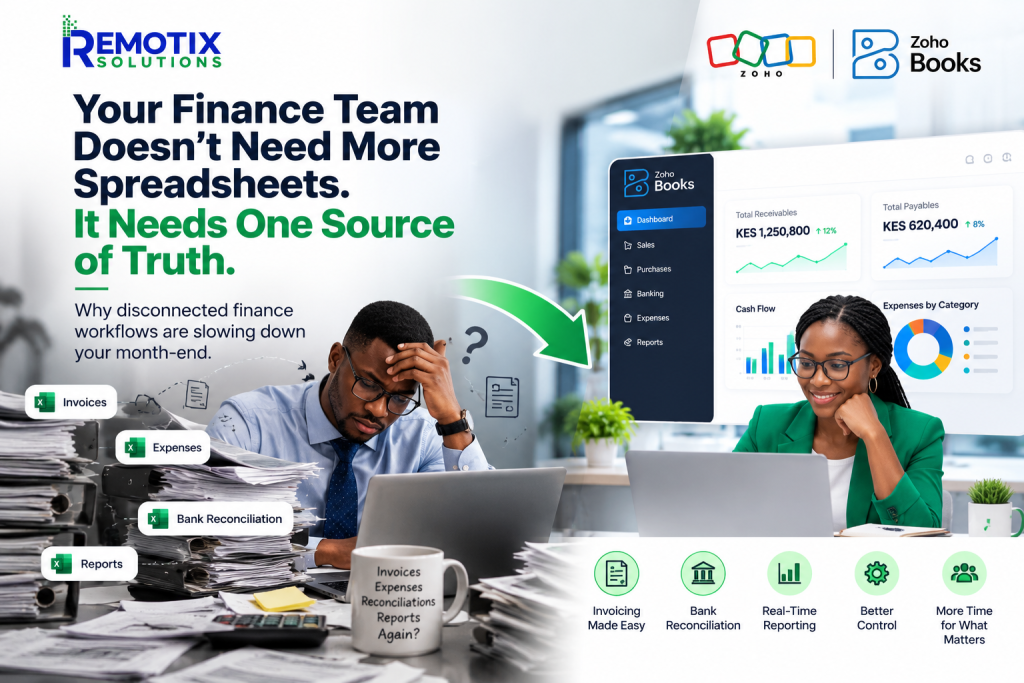
Why disconnected finance workflows are slowing down your month-end
There is a point where spreadsheets stop being a useful finance tool and start becoming part of the problem.
One file tracks invoices. Another tracks expenses. Bank transactions sit somewhere else. Someone has a separate sheet for receivables, while management wants a report that requires pulling information from all four.
And when month-end arrives, the finance team becomes the integration layer.
That is where the real cost of disconnected finance workflows begins.
The problem isn’t the amount of data. It’s where the data lives.
Finance teams today have access to more information than ever.
The challenge is getting that information to work together.
A typical workflow might look like this:
Invoice raised → payment received → bank transaction recorded → expense captured → accounts reconciled → report prepared.
On paper, that sounds straightforward.
In reality, each step can involve a different system, spreadsheet or manual process.
That creates questions finance professionals know all too well:
- Has this invoice actually been paid?
- Was that bank transaction already recorded?
- Why doesn’t the receivables figure match the report?
- Which expenses are still outstanding?
- Can I trust this month’s numbers?
- Why am I still preparing this report manually?
The finance team’s time gets consumed by finding, checking and reconciling information instead of analysing it.
What finance teams really need
The answer isn’t necessarily more people or more spreadsheets.
It is a connected finance workflow.
A finance system should allow information to move through the business without requiring someone to manually rebuild the picture every time management asks a question.
This is where Zoho Books becomes relevant.
Rather than treating invoicing, expenses, banking, payables, receivables and reporting as separate activities, Zoho Books brings core accounting processes into one platform.
The objective isn’t simply to automate tasks.
It’s to create one reliable financial picture of the business.
From recording transactions to understanding the business
Consider a finance manager preparing for a monthly management meeting.
The question isn’t:
“How many invoices did we raise?”
The more important questions are:
How much are we owed?
How much cash is coming in?
Where are we spending?
What has changed from last month?
What does this mean for the business?
When financial information is scattered across different files and systems, answering those questions takes time.
When the underlying workflows are connected, finance teams can spend less time assembling the numbers and more time interpreting them.
And that is ultimately where the value of finance lies.
Automation should remove work—not remove control
There is sometimes a misconception that automation means handing everything over to software.
For finance professionals, it should mean something different.
Automation should reduce repetitive work while improving control.
Routine processes such as invoicing, expense management, transaction recording and reconciliation can be structured within a connected accounting environment, while finance professionals retain oversight of the numbers.
The result?
Less time spent chasing information.
Fewer opportunities for manual errors.
More consistent processes.
And better visibility when decisions need to be made.
The real question isn’t “Do we need accounting software?”
Most growing businesses already have accounting software of some kind.
The better question is:
Is our current finance workflow giving us the visibility and control we need?
If your finance team is still spending significant time consolidating spreadsheets, manually checking transactions, chasing outstanding information or rebuilding reports, the problem may not be the team’s efficiency.
It may be the system around them.
A better finance workflow starts with connected information
Technology should not make finance more complicated.
It should make the underlying information easier to capture, reconcile, understand and act on.
For finance teams looking to move away from fragmented workflows, Zoho Books can provide a more connected approach to managing core accounting processes.
Because the goal isn’t simply to close the books faster.
It’s to give finance professionals better information, better control and more time to focus on what the numbers are actually saying.
Thinking about moving beyond spreadsheet-heavy finance workflows?
Talk to Remotix Solutions about Zoho Books and find a finance workflow built around how your team actually works.